

Some books about heartbreak try to make it dramatic. Others understand that the most painful parts of love can be surprisingly ordinary: seeing someone across a room, remembering an old conversation, listening to a song that suddenly means something different, or returning to a place that still carries the memory of another person.
I Still Blame Spring by Baban Chahal appears to belong to the second kind.
A collection of poetry and prose, the book explores the quieter side of unrequited love. It is about feelings that begin before we have fully understood them and relationships that may never become relationships at all. More importantly, it asks what happens after the hope disappears. What remains when the person is gone, but the memories are still everywhere?
I Still Blame Spring: Book Details
| Detail | Information |
|---|---|
| Book | I Still Blame Spring |
| Author | Baban Chahal |
| Publisher | Notion Press |
| Publication date | 18 August 2026 |
| Language | English |
| Pages | 108 |
| ASIN | B0HFML77XK |
| ISBN-13 | 979-8906435507 |
| Format | Poetry and prose |
| Genre | Poetry, Love, Contemporary Writing |
What Is I Still Blame Spring About?
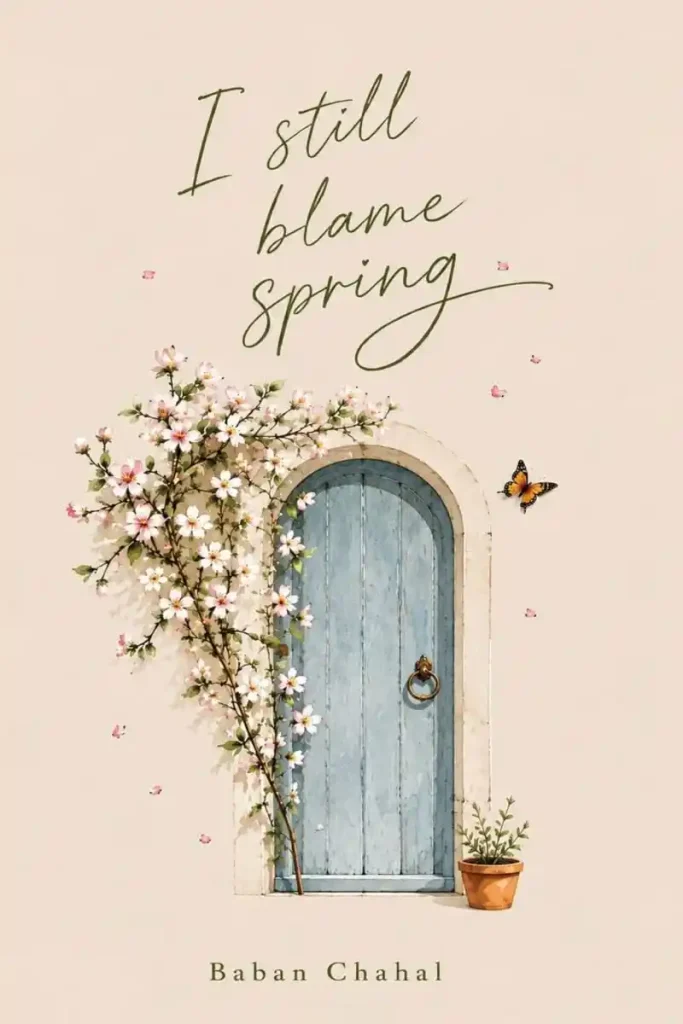
The book revolves around one-sided love, but its description suggests that it is not simply a collection about losing someone.
It begins with the experience of falling in love quietly. There is excitement in noticing someone, comfort in imagining a future and a particular kind of happiness in feelings that have not yet been tested by reality.
Then comes the difficult part: discovering that the imagined relationship may never actually exist.
The book follows that movement through hope, longing, heartbreak and reflection. But its most interesting idea may be what happens afterwards. The person may leave, but the places, songs, seasons and memories associated with them can remain.
That is where the title becomes meaningful.
Why blame spring?
Because sometimes a season becomes attached to a particular person or period of life. The season itself has done nothing wrong, but it becomes impossible to experience it without remembering what happened during it.
A Book About the Aftermath of Love
One thing that stands out from the description is that I Still Blame Spring does not appear to treat heartbreak simply as the moment when someone leaves.
Instead, it focuses on the emotional residue.
A familiar song can suddenly become painful. A particular place can feel different. A season can bring back memories that seemed to have disappeared. Even parts of one’s personality may have changed because of the experience.
That makes the book broader than a straightforward collection of romantic poems.

It is also about memory and transformation.
The person you loved may not remain in your life, but the version of yourself that existed because of that love does.
You may like: I’m Done, But My Heart Still Whispers Your Name by Ankit Bhatt
Poetry and Prose Together
The combination of poetry and prose suits the subject particularly well.
Poetry can capture an emotion in a few lines, while prose can linger over a memory or a situation. For a book dealing with feelings that are often difficult to explain directly, moving between the two forms can create different ways of approaching the same emotional experience.
At 108 pages, the book is also relatively short. That makes it the kind of collection a reader could potentially return to rather than necessarily consume as a long continuous narrative.
Read: All This Love Poems by Ashish Bagrecha
What Makes the Book Relatable?
The strongest appeal of I Still Blame Spring is likely to be its familiarity.
Almost everyone has experienced some version of holding onto something that never quite became what they hoped it would become. That does not necessarily have to be romantic love. It can be a friendship, a missed opportunity, a particular period of life or simply a person who mattered more than they realised at the time.
The book’s description deliberately leaves room for that interpretation.
For one reader, the poems may be about unrequited love. For another, they may bring back a particular person, place or period that has nothing to do with romance.
That personal element can be one of the pleasures of reading poetry.
Meet the Author: Baban Chahal
Baban Chahal writes across poetry, storybooks and novels. His work explores emotional experiences, imagination and the complexities of human relationships.
His writing interests include themes such as love, ambition, transformation and inner conflict. In I Still Blame Spring, that interest appears to be expressed through a combination of lyrical writing and prose reflections.
Who Should Read I Still Blame Spring?
This book may appeal particularly to readers who enjoy:
- Poetry about love and heartbreak
- Writing about unrequited relationships
- Short prose and reflective pieces
- Contemporary romantic literature
- Books about memory and emotional attachment
- Personal and introspective writing
- Short collections that can be read in small sittings
It may be less suitable for readers looking for a conventional romance with a developed plot and clearly defined characters. This is a poetry and prose collection, so its appeal is more likely to come from individual emotions and reflections than from a continuous storyline.
Also read: Dear Zahira, With Love by Sachin NG
Final Thoughts
I Still Blame Spring seems to understand something that people who have experienced one-sided love will recognise: sometimes the hardest part is not losing someone, but continuing to encounter reminders of them after they are gone.
The book’s description moves through the familiar stages of attraction, hope, longing and heartbreak, but its attention to what remains afterwards gives it a more reflective character.
There is no promise here of a perfect love story. Instead, there is the possibility of recognising one’s own memories in someone else’s words.
And perhaps that is the most appropriate way to approach a book like this.
You don’t necessarily read poetry about heartbreak because you want someone to explain your feelings to you. Sometimes you read it because somebody else has found a way to put into words something you have been carrying quietly yourself.
For readers who have ever associated a song, a place or even a season with someone they could not keep, I Still Blame Spring may feel less like a story about somebody else’s heartbreak and more like an invitation to revisit a memory of their own.
